bevalling
27 Apr, 2025

You are likely between 8 and 12 weeks pregnant.
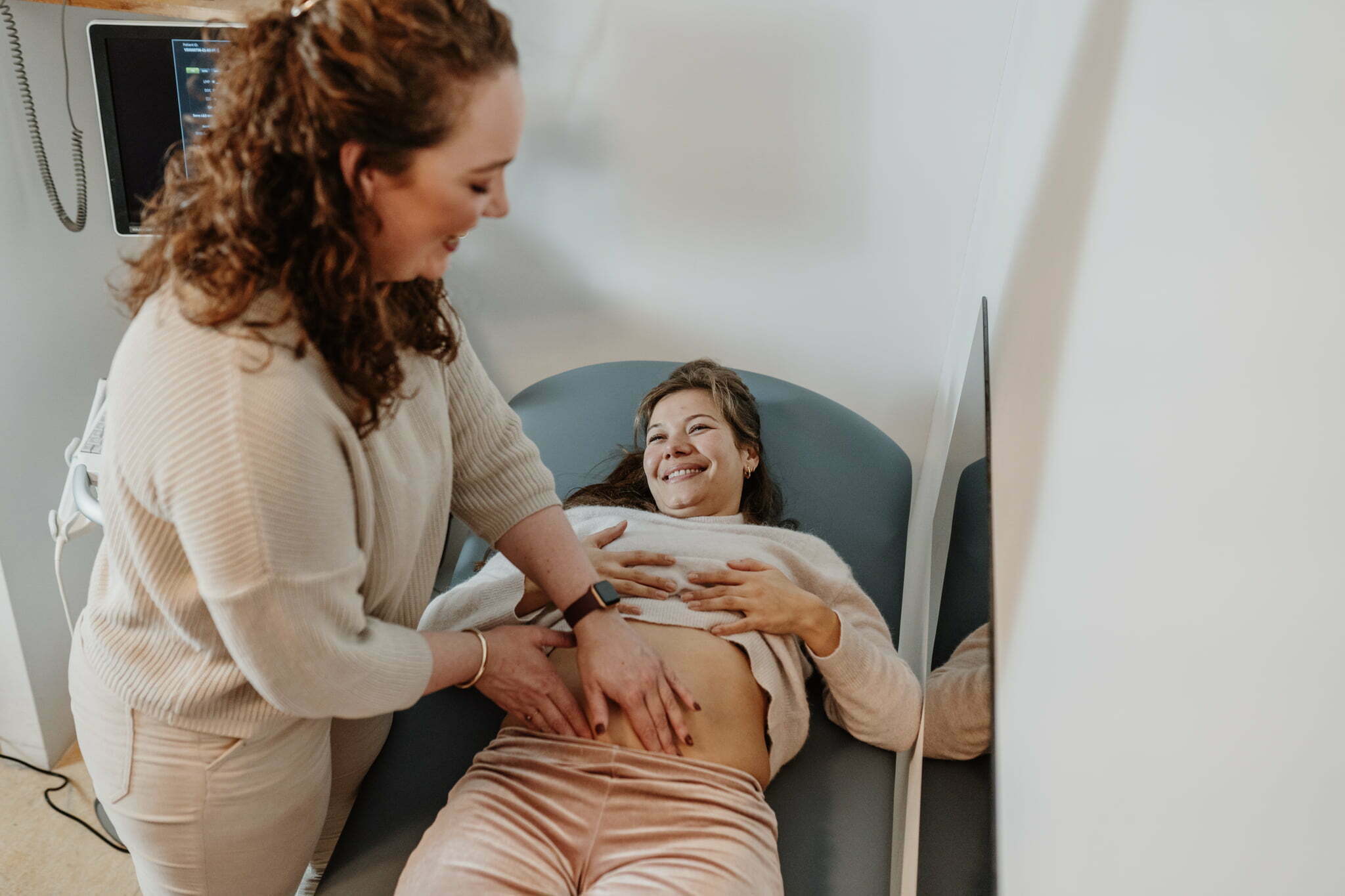
You will see a midwife for the first time for an (early) ultrasound and/or intake. Depending on whether the midwife you see is qualified to perform ultrasounds, this may also be the first time you will see your baby.
There is a lot of information that is relevant not just to you, but to everyone who is pregnant. The information that is not specific to your personal situation will be discussed in group sessions during the online Meeting amstermam. One of our midwives conducts this education session, which is almost as crucial as your intake appointment. During this session, you will receive explanations about the midwifery care system, our practice, nutrition & vitamins, lifestyle & exercise, pregnancy symptoms, sexuality during pregnancy, postnatal care, pregnancy classes, what you need to arrange in the coming months, and more. Additionally, you will learn when to contact us and how to reach us.
During the intake, the midwife takes 45-60 minutes to ensure you have a good start to your pregnancy. The intake consists of several parts:
The midwife asks you and your partner many questions about your medical history. This includes your general health, whether you have been pregnant before, and whether there are any congenital abnormalities or diseases in the family that could affect your pregnancy. For an overview of the questions asked, please refer to the questionnaire sent to you after registration.
Naar aanleiding van de anamnese stelt je verloskundige samen met jou een zorgplan op. Welke onderzoeken raden we je aan om te doen de komende maanden? Maar ook: wat zijn redenen om contact op te nemen met je verloskundige? In het ZORGPLAN lees je er meer over.
If you wish, we will discuss prenatal testing with you and support you in making a choice. The conversation focuses on your choice. We will discuss the potential consequences of a particular result, such as whether you would consider terminating the pregnancy if your baby is not healthy. Do you want to know everything you can know? Finding the answers to these questions will hopefully guide you to make an informed choice. Read more about prenatal testing at https://www.pns.nl/en/.
The midwife measures your blood pressure, calculates your BMI, and examines your abdomen. If you are less than 12 weeks pregnant, the heartbeat will not be listened to for medical reasons.
The midwife provides you with information and referrals for blood tests, arranging maternity care, and any prenatal tests that may be necessary.
If the midwife who conducts the intake appointment is qualified to perform ultrasounds, she will carry out an early ultrasound or a dating scan. Otherwise, a separate appointment will be scheduled for this.
During or after the intake, blood is drawn. In the Netherlands, it is standard practice to test all pregnant women for their blood type, Rhesus D factor, Rhesus C factor, syphilis (lues), HIV, and Hepatitis B. Additionally, we assess your iron levels. Depending on your work conditions, dietary habits, or medical history, further tests may be recommended.

If you have registered at amstermam, you will be offered a free "early ultrasound" between 8 and 10 weeks of pregnancy. This ultrasound checks for a heartbeat, confirms the embryo is in the uterus, and identifies the possibility of a multiple pregnancy. Women who have had a previous miscarriage or experience vaginal bleeding will always receive this ultrasound.
Between 9 and 12 weeks, the pregnancy term can be measured most reliably. During the term ultrasound, the length of the embryo from crown to rump is measured. Using this length, we can determine the exact due date. All embryos grow at the same rate up to 14 weeks. However, knowing the exact due date doesn't predict when you will go into labor. Typically, normal term for delivery is between 37 to 42 weeks. The due date is set at 40 weeks, so it's normal to deliver from 3 weeks before to 2 weeks after your due date.

What is prenatal screening?
During your pregnancy, you can choose to have tests to check whether there are indications that the baby in your womb has a chromosomal abnormality or a physical abnormality. This is called prenatal screening.
There are two types of screening:
Would you like to know more about these tests? During the intake we will look together at what you need in order to make the choice that suits you best. You can also ask any questions you may have.
Read information about the tests before the appointment. You can find more information at www.pns.nl/en/, for example:
Whether or not to have the tests: that is your choice.
The NIPT, 13-week scan, and 20-week scan are not mandatory. You decide for yourself whether you want to have one or more of these tests and what you do with the results. You can also stop the testing at any point.
A normal NIPT result has a reliability of 99.9%. An abnormal result is slightly less reliable. For example, if the NIPT indicates that the baby has Down syndrome or Edwards syndrome, in 2–4% of cases this result is incorrect. For Patau syndrome, the result is incorrect in as many as 47% of cases. Therefore, a chorionic villus sampling (CVS) or amniocentesis is always offered to confirm such a result. The results of these tests provide a definitive answer as to whether or not the baby has one of these three syndromes.
As part of the screening, between 12 weeks and 3 days and 14 weeks and 3 days of pregnancy, you can undergo the 13-week ultrasound. During this ultrasound, we examine whether your child has any physical abnormalities. We also assess the amount of amniotic fluid and the growth of your child.
Later in pregnancy, you can choose to have a 20-week ultrasound where we again examine the baby from head to toe. Read more about this in 'I am almost halfway'. episode 4 of the 9-monthplan.
For all these examinations, read more about them on https://www.pns.nl/en/.
From 15 weeks of pregnancy onwards, anyone, including those outside our practice, can come for a gender ultrasound. Read more about it here .


Hello! Subscribe to our 9-month plan by entering your due date and receive relevant information automatically in your inbox when you need it. Accessible to everyone, even if you are not registered with our practice.



The most frequently asked questions can be found here. Didn't find the answer you were looking for? Please contact . We are available by phone every day until 1:00 PM, and by email all day.


You're welcome to join our online introduction session Meeting amstermam, given by one of our midwives. Here you will get acquainted with our approach and practice.

Register now without obligation within 2 minutes, and receive a response within one working day!